- The number of hay days matters more than the amount of hay per day
- Stocking rate and stocking density come first
- Stockpiling tall fescue for winter grazing
- Grazing rough ground that was never meant to be pasture
- How much hay our cattle will eat this winter
- How we move the herd: lanes, polywire and rest
- Tracking grazing moves in a spreadsheet
- Getting to zero hay
- What I’d tell someone starting out
By late October, a neighbor down the road was already feeding hay. He runs about 70 head, puts out two to three round bales a day, and usually keeps at it until mid or late March.
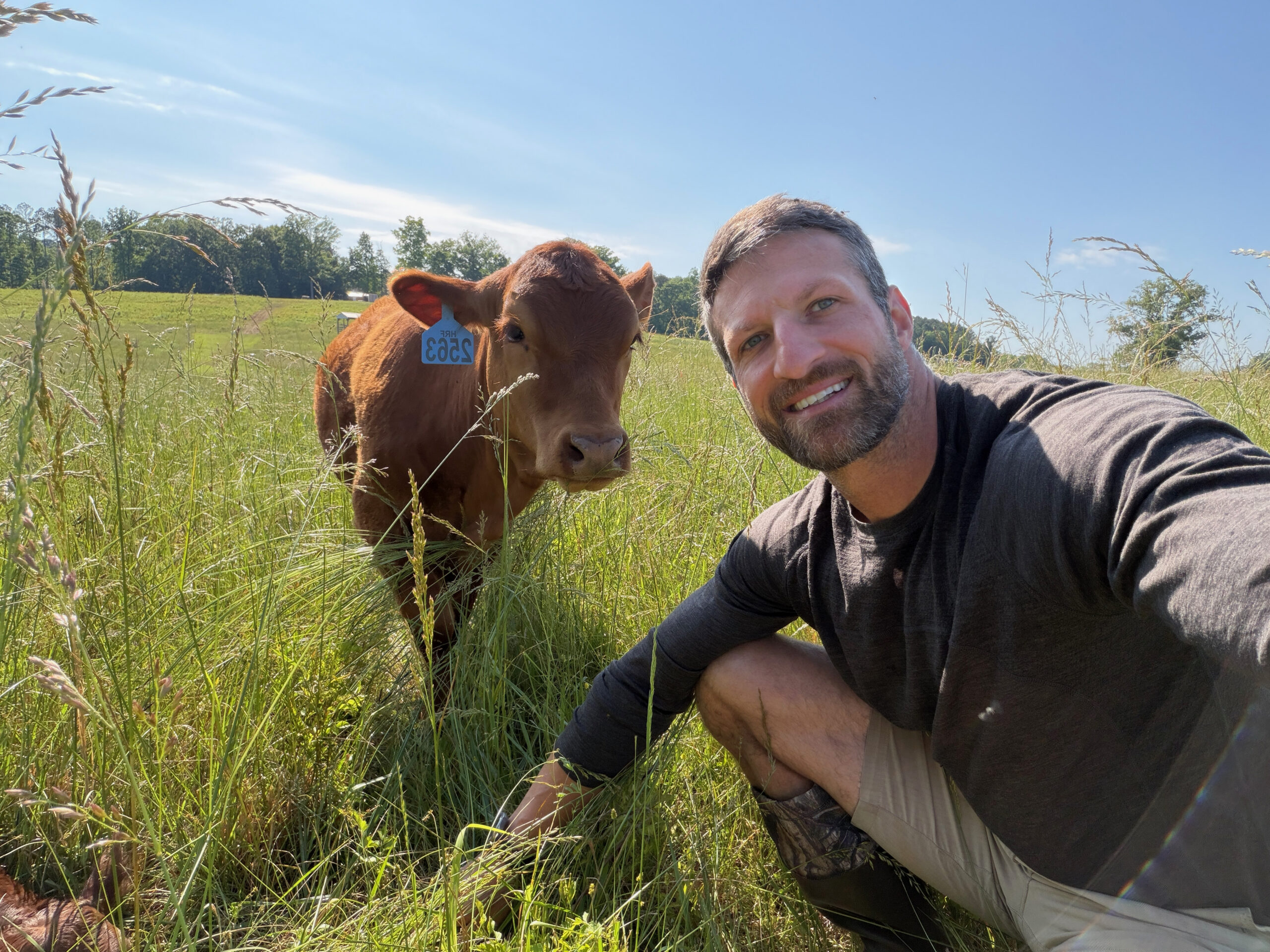
Meanwhile, our seven head are still grazing.
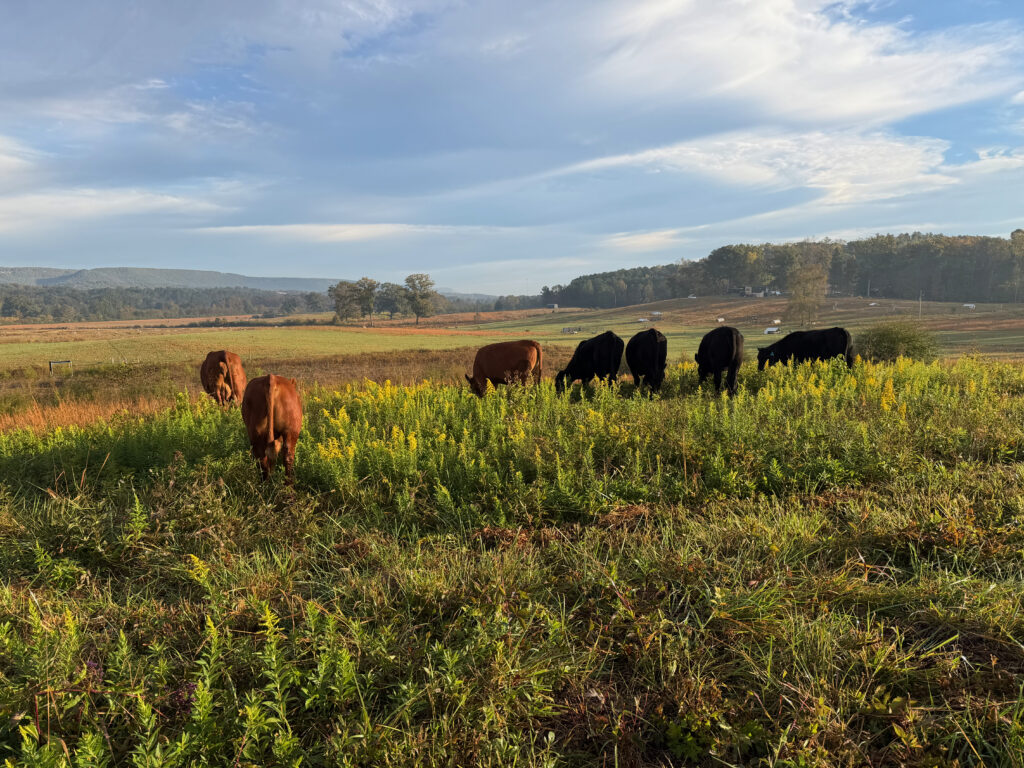
This is our first winter with cattle, since we only brought them onto the homestead this spring. I log every cattle move in a Google Sheet that also forecasts where the herd goes next and when we’ll run out of grass.
I’ll explain how it works, and share a free copy, near the end of this post. Based on what we’ve grazed so far, it says we won’t unroll our first bale of hay until around January 18 – and that the whole winter will take somewhere around 16 to 18 round bales.
Now, I’m not writing this article to compare our setup up against our neighbor’s. Raising 70 cows is a different job than raising seven, and I don’t know his acreage or his bale weights.
What I do know is that he told me he’d run out of grass. And that made me sit down and work out why our numbers look the way they do.
Most of the answer is stockpiling: grass that grows in late summer and fall, stays standing, and gets grazed in winter. Stockpiling only works if there’s grass to spare, though, so the place to start is stocking rate.
The number of hay days matters more than the amount of hay per day
Per animal per day, we feed about as much hay as our neighbor does: two to three bales spread across 70 head is roughly 0.03 to 0.04 bales per animal per day. Once we start feeding, our herd will go through one 700-pound round bale about every five days (I walk through that math further down), which comes out to 0.03 bales per animal per day.
The difference is the number of days. Feeding from late October to mid or late March is somewhere around 140 to 155 days of hay. At his daily rate, that’s 4 to 6.5 bales per head for the winter. We’re planning on about 2.5 bales per head, because we expect to feed for roughly 75 days, from mid-January until the grass starts growing again, instead of 150.
The daily ration doesn’t leave much room to cut, apart from reducing waste. The number of hay days does, and that number gets decided months before the first bale comes out, by how many animals are on how much ground and how that ground is managed through summer and fall.
Stocking rate and stocking density come first
Two terms get mixed up constantly, and they mean very different things.
Stocking rate is how many animals you carry on all of your grazing acres over a period of time, usually a season or a year.
Stocking density is how many animals are on a specific piece of ground at one moment, like today’s strip of pasture, fenced off with a single strand of temporary electric fence called polywire.
A farm can have a low stocking rate and a very high stocking density at the same time, and ours does.
Both are usually expressed in animal units. University of Georgia forage specialist Dennis Hancock defines one animal unit as 1,000 pounds of body weight. That makes it easy to compare a herd of yearlings to a herd of mature cows, since what matters to the grass is how many pounds of animal are eating it.
Here’s our herd, with the weights we use in the spreadsheet. These are estimates, and I’ll replace them with weigh-tape numbers when I get them:
- One South Poll cow, about 1,050 pounds.
- Her bull calf, about 450 pounds.
- One South Poll yearling and four Black Angus born around October 2025, about 650 pounds each.
That’s roughly 4,750 pounds of cattle, or 4.75 animal units. The paddocks we rotate the cattle through add up to 29.7 acres, so our stocking rate is about 6.25 acres per animal unit.
For context, Hancock’s rule of thumb for Georgia is one animal unit per 1.25 to 2.5 acres, and a UGA county Extension article puts most pastures at around 2 acres per animal unit.
By that range, our acres could carry somewhere between two and a half and five times the cattle we have on them.
Now, sitting down with a notebook to calculate animal units for just seven head spread across 29.7 acres felt ridiculous at first — like I was overcomplicating a small homestead setup with corporate grazing math.
But light stocking is the biggest reason we can graze into January.
Rotation, rest and stockpiling all matter, and I’ll get to them, but they work on top of a stocking rate that leaves grass on the table going into fall. If we doubled the herd tomorrow, I’d expect to be feeding hay a lot earlier no matter how often I moved the polywire.
This is also our first season with cattle, so I have no previous winter to compare against. These numbers are a starting point, and this winter is the first real test of them.
How to calculate your own stocking rate
If you want to run this for your homestead or farm, add up the estimated weights of everything that grazes, divide by 1,000 to get animal units, and divide your grazing acres by that number.
Bigger animals count for more. A UGA example shows a 1,150-pound cow working out to about 1.16 animal units, so she needs about 2.3 acres where a 1,000-pound cow would need 2.
UGA also publishes animal unit equivalents for different classes of cattle, which is handy if you’re mixing cows, calves and yearlings like we are.
Then compare yourself to your region’s numbers honestly. If you’re near the heavy end of the range, there probably won’t be much grass left to stockpile in the fall, and the hay season will start whenever the grass stops growing.
Stockpiling tall fescue for winter grazing
Our grazing spreadsheet assumes the fescue stops growing around November 15 and starts again around April 1, following UGA’s description of late November through March as the lean period for north Georgia fescue.
In other words, whatever grass is standing in a paddock on November 15 is what that paddock has to offer until spring.
That standing grass is the stockpile.
Our main pasture fields – which we call Hayfield, Big Well, Pond and Oak Tree – are each split into smaller sections we call lanes, which are about 0.7 to 1.8 acres apiece.
This winter’s stockpile is in the Hayfield, Oak Tree and Big Well lanes. The herd last grazed the Hayfield and Oak Tree lanes in July and August, and Big Well in September, and nothing has touched them since.
By the time the cattle walk back into the Hayfield in mid-November, those lanes will have rested for three to four months.
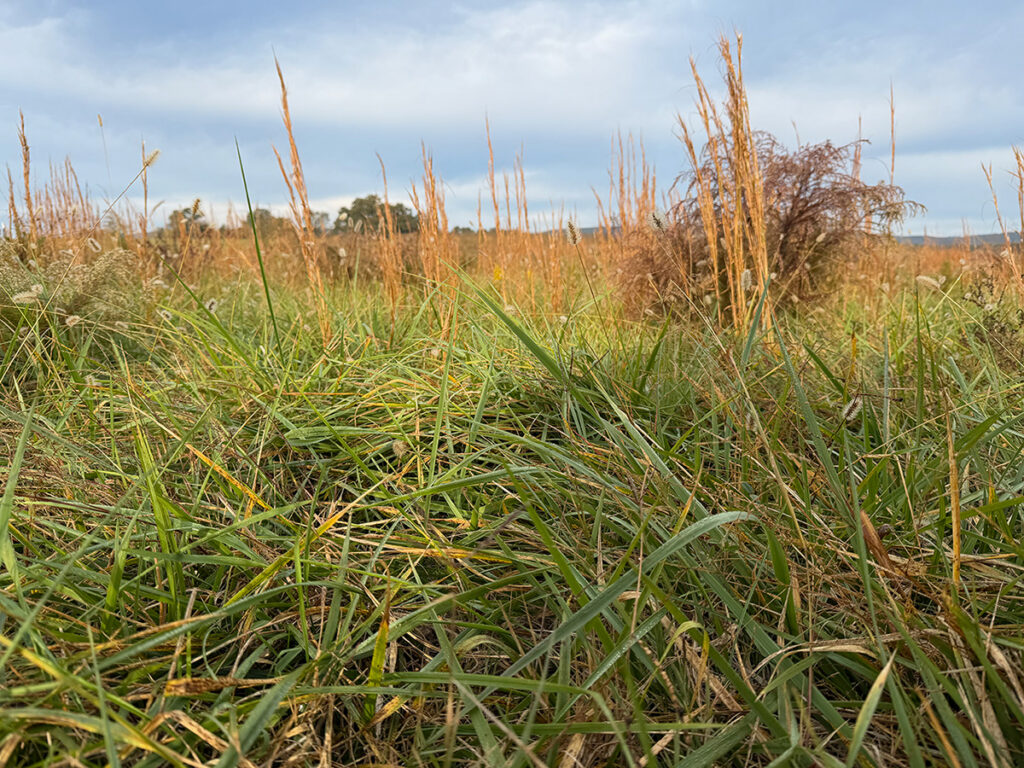
Standing at the gate in late October and looking across the Hayfield lanes, the visual is striking: a thick, golden-green canopy of 12 to 15 inches of standing fescue, punctuated by tall brown tufts of broomsedge. (Broomsedge is one of the few things the herd left completely untouched on our rough ground this fall, so I’m not counting it as feed.)
Tall fescue is a good grass for this. NC State Extension explains that it stays vegetative in the fall without stems or seed heads, and that its sugar content and digestibility are high going into winter. Its quality does drop over the winter, and Oregon State’s forage information puts typical dry matter losses at around 25%, but the decline is much smaller than with other stockpiled forages.
There’s another reason to graze fescue stockpile later rather than sooner. Our fescue is Kentucky 31 (KY31), like a lot of older stands in the Southeast. It carries an endophyte, a fungus that lives inside the plant and produces ergovaline, the toxin behind fescue toxicosis.
Among other things, ergovaline constricts blood vessels.
Normally, cattle cool off by sending more blood to their skin, so narrower vessels make it harder for them to shed heat, and thus they overheat more easily.
We saw that firsthand this spring.
Walking the pastures on a 95-degree day, our Black Angus were visibly panting, seeking any sliver of shade under the fence lines (before we invested in a mobile shade structure) after gorging on fescue seed heads like candy.
Meanwhile, the South Poll cows were walking around completely unfazed, grazing normally.
The Angus were clearly suffering from heat stress brought on by ergovaline toxicity. Seeing that contrast in real time made me realize just how potent those seed heads are compared to leafy vegetative growth.
Winter works the other way. Missouri research cited by Oregon State found that ergovaline in Kentucky 31 fescue dropped about 85% from October to March. The later in winter the herd eats it, the less toxin they take in.
How many grazing days our stockpile should provide
The spreadsheet estimates how long each paddock will last using what our pastures produced during the growing season. So far, each acre has fed the whole herd for about four days on average. On that basis, it gives us about two months on stockpile – from mid-November to mid-January.
Extension numbers suggest a well-managed stockpile can carry a lot more than that. For example, a UGA article says stockpiled fescue usually produces 2,000 to 3,000 pounds of standing dry matter per acre, and an NC State Extension agent writes that half an acre of stockpiled fescue should provide 60 to 90 days of grazing per animal unit.
We have about 15 acres of stockpile for 4.75 animal units, roughly six times that half acre per animal unit.
That’s a big gap, and some of it is real. Those extension figures assume nitrogen fertilizer in August, a pasture grazed or mowed down to a few inches before stockpiling starts, and strip grazing through the winter.
Our chickens run on part of these pastures, but most of our stockpile gets no fertilizer at all.
The weather matters too. 2026 has been a drought year here. After we moved the herd off the Hayfield lanes in August, the grass didn’t start growing again or turn green until the first rain a few weeks ago. That felt late to me, and I put it down to the lack of rain. The stockpile is likely smaller than it would be in a wet year. That’s the main reason I’m not counting on the extension numbers this winter.
What I don’t have yet is a measurement of how much forage is actually standing out there. That’s the next step: a grazing stick (a measuring stick that estimates forage per acre from grass height and density) or a few clipped and weighed samples, so the spreadsheet’s forecast comes from our ground instead of from our summer average. If it turns out the forecast is too cautious, the hay date moves later. In a drought year, I’m not expecting that.
Grazing rough ground that was never meant to be pasture
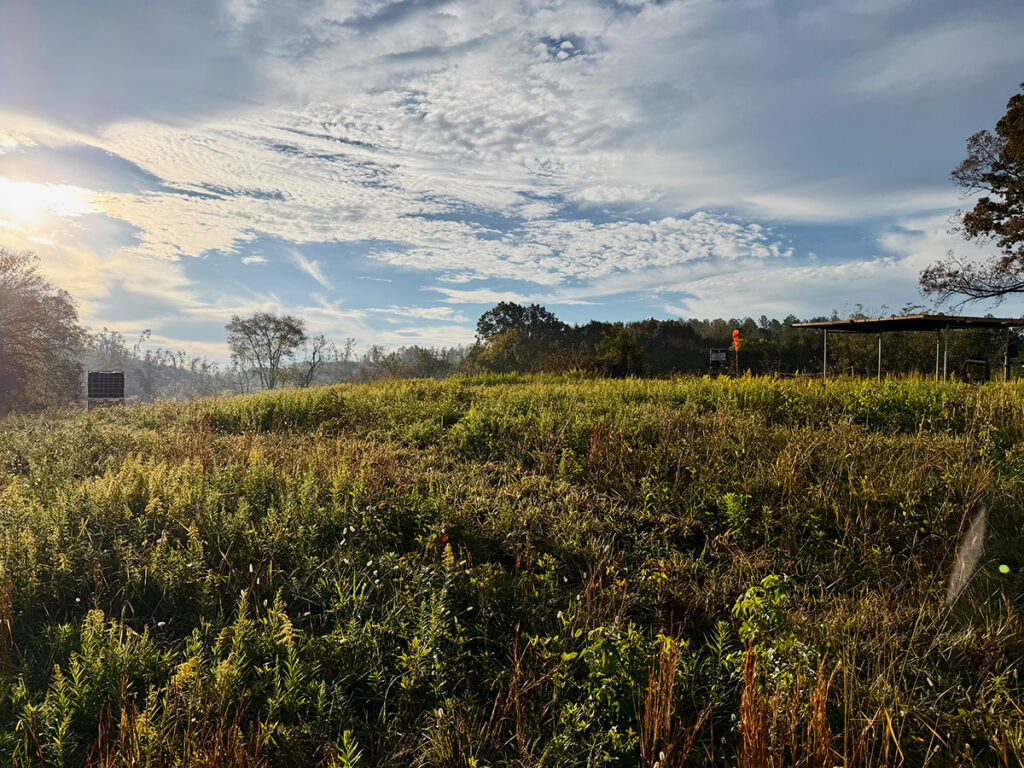
The other piece of this winter’s plan is about 10 acres that were never part of the grazing system. These areas have some fescue, but mostly blackberry brambles, goldenrod and broomsedge (plus brush where the previous owner dumped the stumps of trees he cleared) and four trees. None of it had ever been grazed or cut for hay.
Here’s how those areas – again with the names we use for them – fit into the fall:
- Lightning Strike (2.4 acres): 10 days, October 11 to 21.
- New House (2.4 acres): where the herd is as I write this, through about October 30.
- Old Shooting Range (1.8 acres): about 7 days.
- South Gate (1.1 acres): about 4 days.
- South of Orchard (2.1 acres): about 8 days, through roughly November 18.
That’s about 38 days of grazing from ground that grew nothing useful to us last year.
On this ground, I give the herd a few days’ worth of space at a time – usually about three and always less than five – instead of the daily breaks I use on the main fields.
Watching what the cattle chose was one of the more interesting parts of the fall. They ate the fescue, the young and tender weeds, sorghum, and the leaves off any bushes and trees they could reach. The only things left standing were goldenrod, broomsedge and blackberry.
Those 38 days do two things.
Every day the herd spends here is a day it isn’t eating stockpile, so the stockpile lasts later into winter. And because they’re grazing the rough ground first, the herd reaches the fescue stockpile later in the season, when ergovaline levels are lower.
Water was the main obstacle, and solving it was a brutal physical workout. These rough areas had no water infrastructure whatsoever. To get water up the hill, I hauled two 275-gallon IBC totes into position and wrestled heavy 2-inch K-Line poly pipe through thick blackberry briars and tangled brush, getting snagged and scratched at every turn.
I wrestled the pipe uphill from a hydrant a few hundred feet away, praying the hydrant had enough pressure to push water to the top. It did, and now the totes gravity-feed a movable trough that’s attached to a mobile shade structure that travels with the cattle from paddock to paddock.
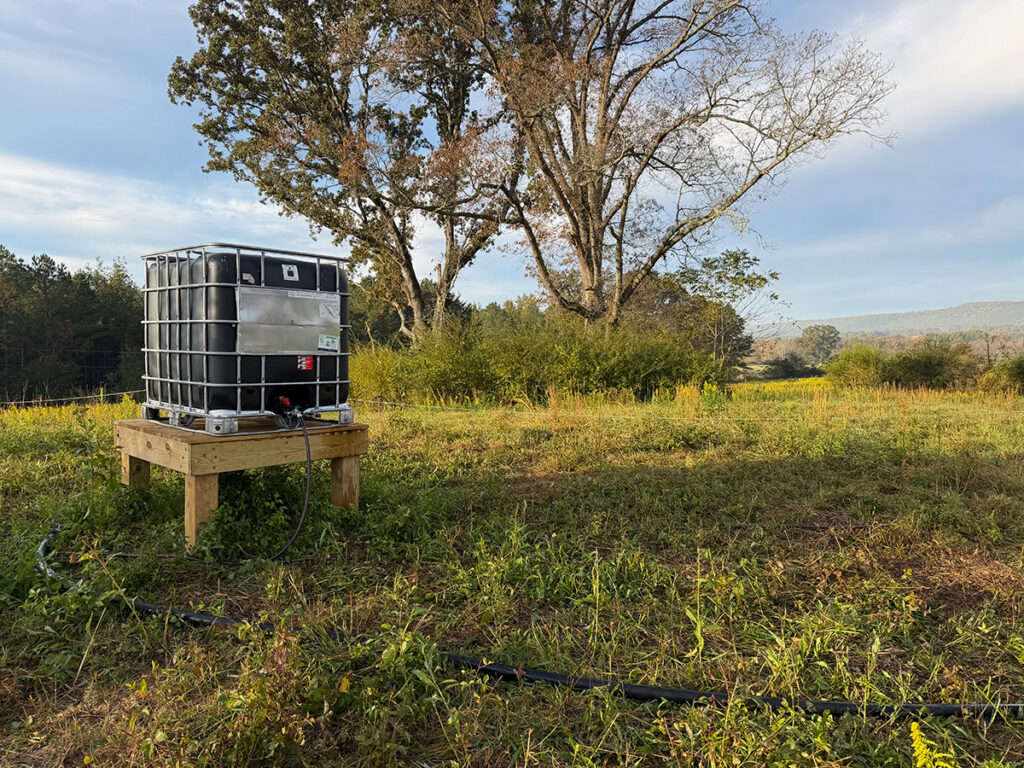
For the cattle, these weeks mean walking and grazing fresh ground every few days instead of standing around a feeding area waiting for hay.
How much hay our cattle will eat this winter
Our hay estimate is simple enough to check by hand, and I’d encourage anyone to run their own numbers this way.
University of Kentucky beef specialist Roy Burris suggests a rough estimate of 2% of body weight per day for winter hay.
For our 4,750 pounds of cattle, that’s 95 pounds of dry matter a day.
Dry hay is about 88% dry matter, so that’s about 108 pounds of hay as fed, meaning including its moisture. Then there’s waste. We unroll our round bales on pasture, and when one bale covers several days we assume about 25% waste – so we need to put out about 144 pounds a day for the cattle to eat 108 pounds of it. With 700-pound bales, that’s one bale about every five days. Over 75 days, it comes to about 16 bales.
Unrolling on pasture means the wasted hay and the manure land on the field instead of piling up around a hay ring feeder. Oklahoma State notes that hay waste gives no return unless the residue gets spread across a pasture.
Our only experience feeding hay so far was this spring, and it was a reality check. Unrolling a 700-pound round bale by hand without a tractor attachment is backbreaking work — heaving, pushing, and straining against hundreds of pounds of compacted forage while muddy boots slip in the dirt.
And when that wasted 25% lands on the ground, it isn’t just an abstract math figure; it’s a matted, yellow carpet of trampled grass, dung, and mud several inches thick that the cattle refuse to touch once they’ve stepped on it.
Improving pastures takes time, so we’ll be buying hay this year and probably for a few more. Until we get to zero, that hay does something useful beyond feeding the herd. Every bale is grass grown on someone else’s fields, and what the cattle leave behind as manure and wasted hay brings that fertility onto ours.
We’re a homestead, not a commercial cattle operation, so I don’t run our winter as a profit and loss statement. But for anyone who does, winter feed is usually the largest single cost in a cow-calf operation, and the number of hay days is one of the biggest drivers of that cost.
For us, hay is money, equipment, and something to depend on someone else for.
How we move the herd: lanes, polywire and rest
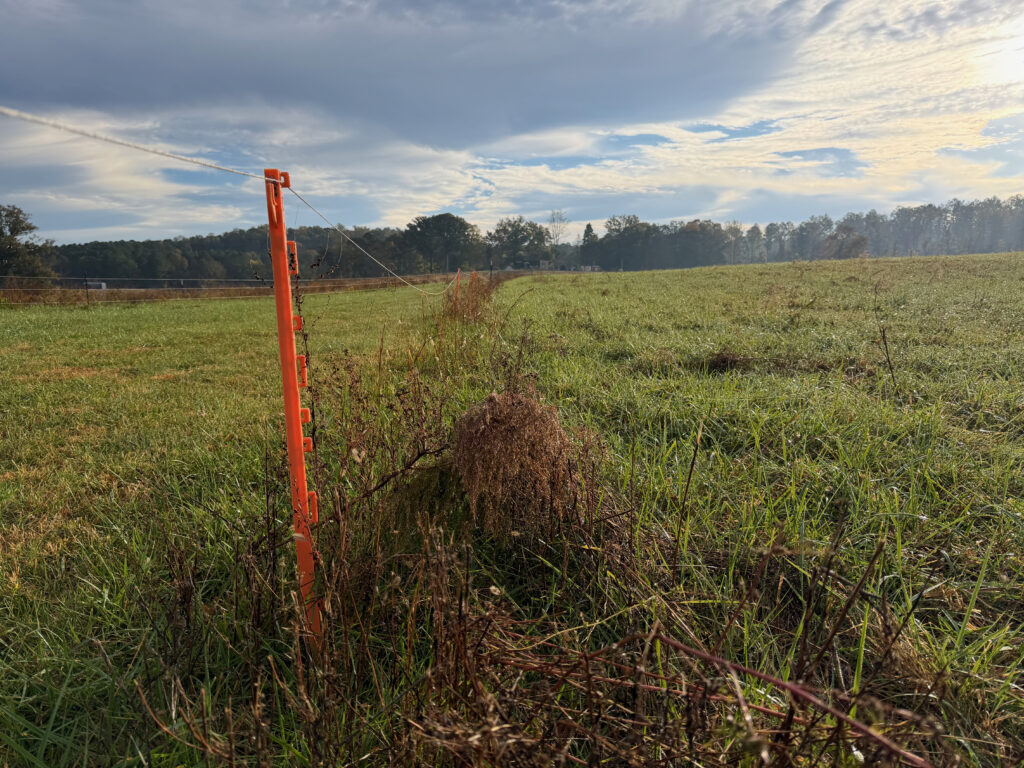
Within a lane, I’ve been moving the cattle to fresh grass every day with polywire and lightweight step-in fence posts. Each day’s strip is called a break.
When I divide each lane by the number of days the herd spent in it, a typical daily break works out to somewhere between a sixth and a third of an acre. That puts our stocking density at roughly 16,000 to 28,000 pounds of cattle per acre on any given day.
Our stocking rate, spread over the whole rotation, is about 160 pounds per acre. Same seven animals, two numbers a hundred times or more apart. That gap is what rotational grazing is: concentrated grazing for a short time, followed by a long rest.
Our minimum rest is 45 days before the herd can return to a lane during the growing season. In practice, most lanes rested a lot longer than that this year. Big Well had rested between 106 and 145 days before the herd came back in late summer.
I started the grazing spreadsheet on April 17. The herd has been on pasture the whole season since then, but there’s a six-week gap from late May to early July where I didn’t record the moves, so the season totals in the sheet undercount what the pasture actually carried.
Daily moves or every three days?
Going forward, I’m considering moving the cattle every three days instead of every day. This isn’t born of exhaustion or burnout.
Moving the herd, setting up polywire, and checking on the cattle takes about 30 minutes each day. That is a manageable routine. But across a week or a month, those half-hours add up to time that could be spent on other pressing homestead projects and tasks.
So the real question is practical: is that daily 30-minute time investment genuinely paying off in measurable gains for pasture health, parasite control, and animal performance compared to a three-day rotation?
Manure distribution. The most cited numbers come from University of Missouri work. Under continuous grazing, it would take about 27 years to get one manure pile on every square yard of a pasture. Moving the herd every two days, it took about two years. A USDA NRCS grazing presentation that reproduces the Missouri table lists 14-day rotations at 8 years and 4-day rotations at 4 to 5 years, and then notes that no research has measured daily or multiple-moves-per-day systems. Graziers say those spread manure very well, and I agree from what I see, but the measured gains in this table come from going from weeks to a few days. A three-day move sits right in the range where the data says you’re already doing well.
Grazing efficiency. Jim Gerrish, who ran grazing research in Missouri for over two decades, makes the point that the quantity and quality of forage drop with every extra day the herd spends on a paddock. On stockpiled fescue, his group found that three-day strips gave 40% more grazing days per acre than 14-day strips. UGA’s rule of thumb for paddock design is that a two- to four-day rotation works best for most beef operations. With daily moves, the herd gets a consistent diet from one day to the next. With three-day moves, they eat the best stuff first and work down to the rest by day three. How much that matters depends on the animals and the grass budget. It matters more with lactating cows or when grass is tight.
Parasites. This is where the margin gets thin. UGA’s forage team notes that in warm, wet weather, worm eggs in manure can develop into infective larvae in three to four days, and they recommend moving animals within five days. A Wisconsin extension recommendation is to keep animals on a paddock for less than four days and not graze below four inches, since most larvae stay in the lowest few inches of the grass. Three days fits inside both, but in a hot, wet Georgia summer, there isn’t much room to spare. This year’s drought likely worked in our favor here, since the Australian WormBoss program notes that larval development drops off sharply when it’s dry. I’d expect our parasite pressure this year to be well below a wet year’s.
The rest period doesn’t sterilize a paddock either. WormBoss also notes that larvae can survive in a dung pat for five to seven months, longer if the pat crusts over. So our 45-day minimum rest gives the grass time to recover, but it doesn’t mean the herd comes back to clean ground. Residual height matters as much as move frequency.
I’ve already had a taste of it. On the rough ground, the herd got about three days’ worth of space at a time, and it went well. My only concern is wet weather, when the ground under the mobile shade structure we move with the herd gets muddy.
I’m leaning toward three-day moves next season. If I make the switch, the research points to two things to watch: how short the herd grazes by day three, and how the cattle do through the hot, wet part of summer. If they start grazing into the bottom few inches, the breaks are too big for three days.
Tracking grazing moves in a spreadsheet
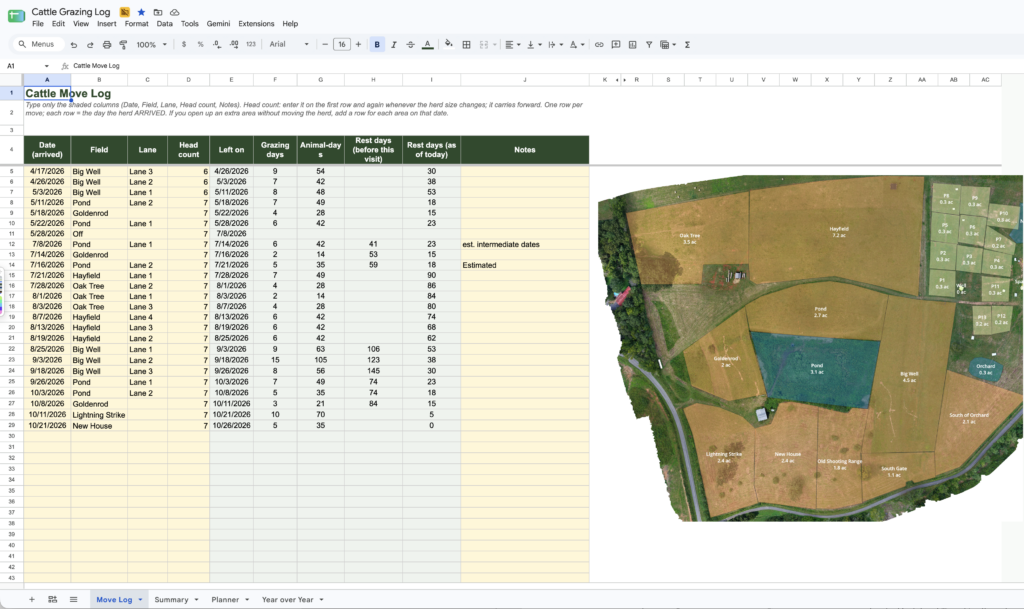
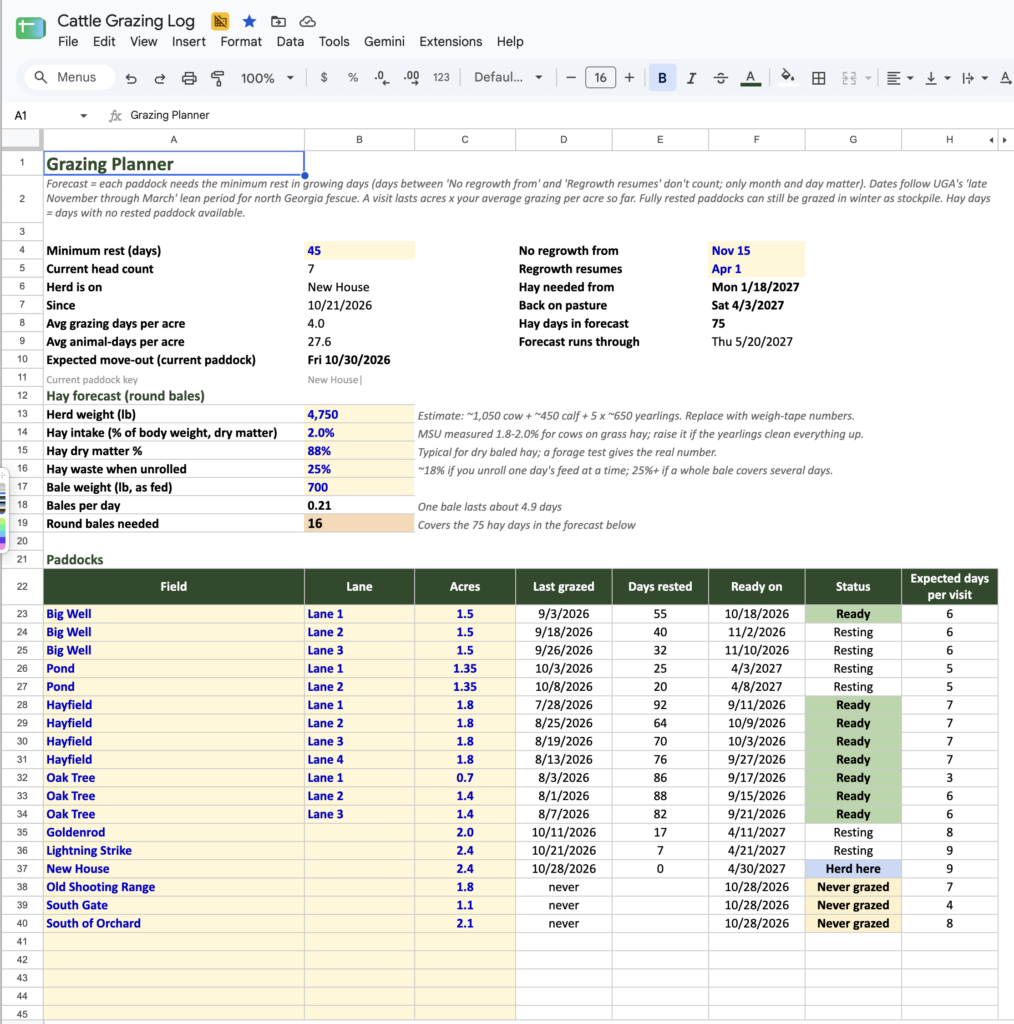
Our own numbers in this post come from the grazing log I keep in Google Sheets. I originally built it to see where the herd should go next and how much rest each paddock had. Then I improved it, along with the one I keep for our pigs, so I could see how the picture changes from year to year. You can only improve what you can measure.
Each time the herd moves, I type in the date and the paddock or lane. The sheet tracks rest days for every paddock, and its Planner tab forecasts the next 20 moves, estimates when we’ll run out of rested grass and how many bales we’ll need, and compares each year to the last so I can see whether the land is carrying more animals over time. The pig version does the same for our 13 pig paddocks, which are each about 100 by 100 feet, with a 60-day minimum rest.
If you want to use them for your own animals, here are read-only versions. Open one and go to File > Make a copy to get your own editable version, then clear out our move history and enter your own paddocks:
I’m also working on an iOS app so anyone can track their grazing without wrestling with a spreadsheet. More on that when it’s ready.
Getting to zero hay
About 2.5 bales per head is a good start, but the goal is to stop feeding hay altogether. Here’s how we plan to get there.
The first part is stockpiling more grass going into winter.
The second part is giving the herd something green in the months when fescue doesn’t grow, by seeding winter annuals and perennials. I want to drill oats, alfalfa, clovers, vetches, rye and anything in between. The goal is a real variety of forages instead of pastures built on a single grass, KY31.
We don’t own a tractor or a seed drill, so we’re borrowing both. The drill comes from the Chattooga County Young Farmers group we belong to, and the tractor from a neighbor.
I’ve also started mixing seed into the alfalfa pellets I hand-feed the cows, using whatever I have in the shed: a chicken pasture mix, alfalfa, sheep fescue and so on. The pellets are mostly a training tool, so the cattle get used to coming to me when I need to move or handle them. Some of the seed passes through and lands in a cow patty, so the cows end up doing a little seeding for me.
I’ll be realistic about the odds. An NC State study found that red clover seed fed to cattle went from 96% germination to 14 percent after passing through the animal, with far fewer seedlings surviving than from direct planting. Hard-coated legume seeds like alfalfa and clovers can often pass through undamaged, but the drill is still doing the real work here. The pellets are getting fed anyway, so whatever sprouts out of a cow patty is a bonus.
The last tool is irrigation. After this year’s drought, I invested in a K-Line farm pack with five pods. It’s a mobile irrigation system: sprinklers sit in weighted plastic pods along a flexible poly line, and I can drag the whole line to a new spot with the UTV. The idea is to keep grass growing through the next dry spell instead of watching the stockpile shrink. We haven’t run it yet, so next year will show how it fits into the rotation.
What I’d tell someone starting out
If you want a shorter hay season, start with the arithmetic before the fencing. Work out your animal units, divide your grazing acres by that number, and be honest about where you fall in your region’s range. If you’re heavily stocked, more paddocks will help, but there may not be enough grass left in October to stockpile.
If your stocking rate leaves room, close some ground in late summer and leave it alone until the grass stops growing. Look around your property for the edges and rough corners that have never been grazed, and figure out how to get water to them. Then write every move down. After one season, you’ll have your own numbers to plan from instead of rules of thumb.
This is our first winter with cattle. We’ll know in spring how close the spreadsheet came. I’ll share the real hay count when the last bale is gone.
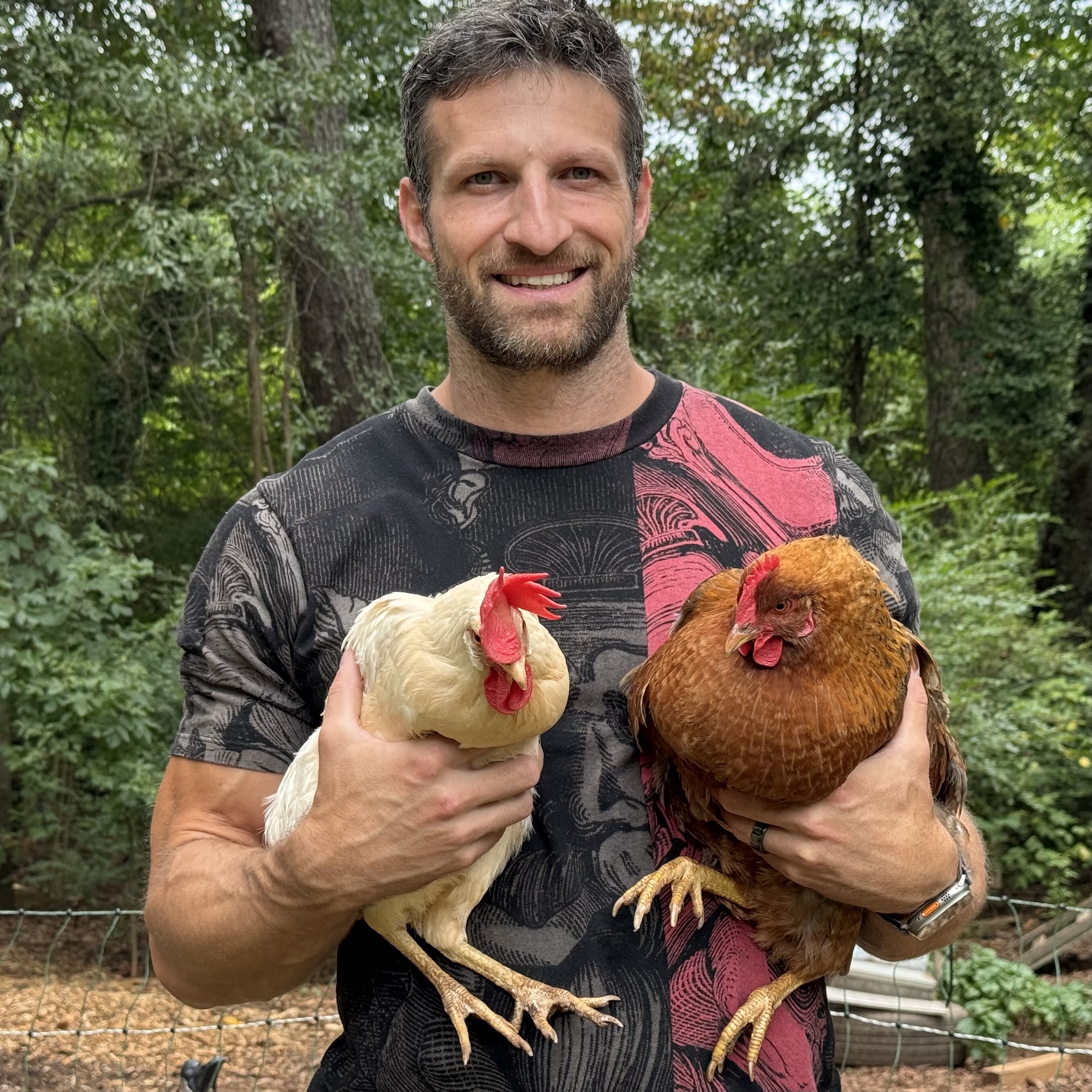
Michael Kummer is a healthy living enthusiast, the founder of MK Supplements and the host of the Primal Shift podcast. His goal is to help people achieve optimal health by bridging the gap between ancestral living and the demands of modern society. He runs the Kummer Homestead with his wife Kathy and their two children.